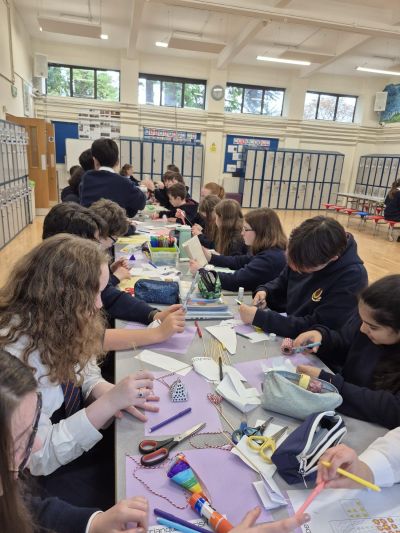
Hebrew Studies students explain the Jewish New Year Holidays

Rosh Hashanah Ref: https://www.bbc.co.uk/newsround/29363650
NEWS / 6 September 2022

On Monday 6th September, 5th Year Hebrew Studies students explained the Jewish New Year Holidays in an online assembly broadcast across the schools through Teams.

In brief the Jewish New Year begins with Rosh Hashanah (this year on Monday 6th September). It is not a fireworks and drinks type of New Year, it is a very serious time. Jewish people spend a lot of time in synagogue praying on these two days. It is a time to stop and think about our behaviour - to try to forgive others and to ask for forgiveness. Foods eaten at this time of the year are very symbolic - the main one being apple dipped in honey. This symbolises sweetness.

The following week is Yom Kippur (Thursday, 16th September). It is the holiest day of the Jewish Year - the Day of Atonement. This is difficult as it means 25 hours of fasting without food or drink mostly spent in the synagogue praying.

Sukkot follows on 22nd and 23rd September. It is a seven day holiday with an outdoor twist - an outdoor room or hut called a sukkah is built. The main tradition on Sukkot is to make a blessing over a special group of four items: a palm branch called a lulav, a citron fruit like a lemon called an etrog, and leaves from myrtle and willow trees.

The final two day holiday is on 28th and 29th September called Shemini Atzeret and Simchat Torah. The main event is the annual completion of reading the Torah scrolls. There is lots of singing and dancing, with flags and sweets for children.

Noam, Sarah, Jonah (5th Year Hebrew Studies students)

More News

General School News, Green Schools, Transition Year / 22 October 2026
Chaos Bulb Planting with TY Students

Chaos Bulb Planting with TY Students

The TY Horticulture class were out in the Autumn sunshine planting Spring bulbs using the chaos planting method. This is when a multitude of different spring bulbs (Hyacinths, Daffodils, Tulips, Crocuses, Narcissi) are mixed together and randomly planted so that we have a mixture of flowers and patterns emerging in the spring. It mimics nature and so is more enticing to pollinators and native insects that need the food in Spring.


Read more →
Subject Blogs, Science/Maths, General School News, Junior Cycle, Transition Year / 15 October 2026
Maths Week 2026: daily puzzles, crack the code Treasure Hunt, Rubik's Cube race ... and more!

Maths Week 2026: daily puzzles, crack the code Treasure Hunt, Rubik's Cube race ... and more!

Stratford is celebrating Maths Week 2026 (12th - 18th October) with daily activities around the school, at breaktimes and in Maths classes! The tutor-time daily quiz is proving to be extremely competitive as each form group tries to solve it and then run to find Ms Matthews in order to win the box of chocolates!

Read more →